


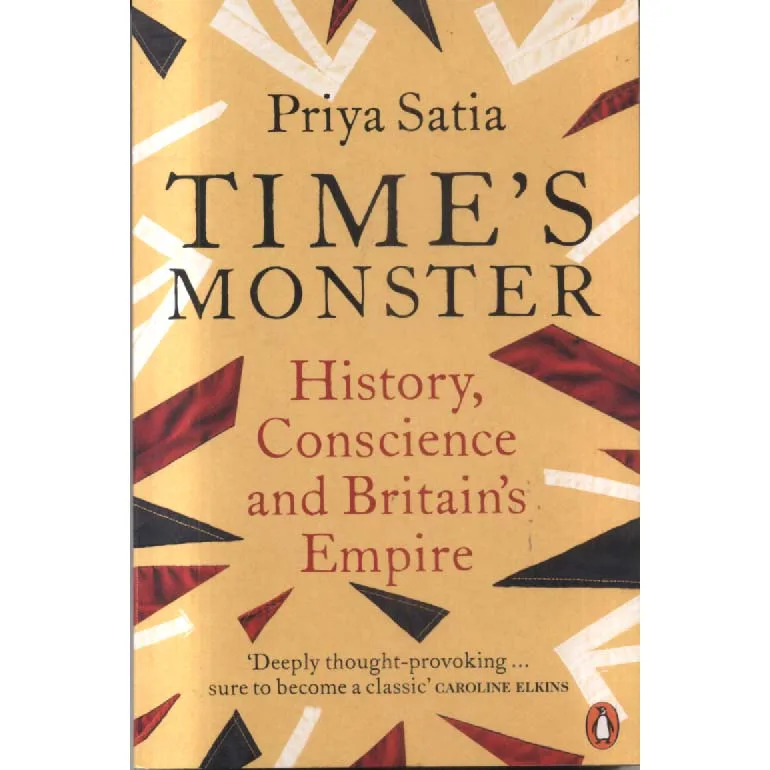
Times Monster - History Conscience And Britains Empire
Publisher: Penguin
Format: Paperback
ISBN: 9780141993928
Time’s Monster – History, Conscience and Britain’s Empire (2022) by Priya Satia
Penguin
ISBN: 9780141993928
Condition: As New
Empires generally prefer to write their own reviews.
Fortunately, historians have a habit of turning up later and checking the footnotes.
In Time’s Monster, historian Priya Satia takes on the enormous question of how Britain understood, justified and eventually questioned its empire, focusing particularly on the relationship between historical writing, moral responsibility and imperial power. This is not simply another account of who conquered whom, which governor signed what treaty or how many red patches appeared on a schoolroom map.
It is about the stories Britain told itself while all of that was happening.
And stories, as Satia demonstrates, can be extremely useful things when you happen to be running an empire.
History could portray conquest as progress, expansion as civilisation and domination as part of some grand historical process through which everybody would eventually benefit, although certain participants were understandably less enthusiastic about the timetable.
Satia explores the thinkers, historians, politicians and intellectual traditions that helped construct these ideas, showing how interpretations of the past could become arguments for actions in the present.
If history was supposedly moving in a particular direction, then empire could be presented not as an exercise in power but as assistance.
Armed assistance, admittedly.
With administrators.
And taxes.
And rather a lot of flags.
The book ranges across centuries of British imperial thought and examines figures who attempted to understand the moral consequences of expansion as well as those who provided intellectual frameworks that made expansion easier to defend.
This gives Time’s Monster a broader scope than straightforward political history. It is interested in conscience: how people reconcile what their society is doing with what they believe to be right.
That is rarely an uncomplicated process.
Human beings possess a remarkable capacity to condemn injustice in principle while discovering elaborate reasons why their own particular version is historically necessary.
Empire provided considerable opportunities for this intellectual exercise.
Satia shows how historical thinking could encourage the belief that Britain occupied a special position in world development, helping to produce a narrative in which imperial expansion became part of humanity’s supposed march towards modernity.
It is an appealing arrangement if you happen to be the country defining both “modernity” and the route everyone else is expected to take to reach it.
But the book also follows critics, doubters and dissenters who recognised contradictions within the imperial project and questioned whether historical destiny was perhaps being used to excuse decisions that looked considerably less noble at close range.
The result is not a simple procession of villains and heroes.
It is an examination of how moral ideas operate inside systems of power, and how even people attempting to behave conscientiously can remain trapped within assumptions their own age has taught them to regard as obvious.
This is where the title becomes particularly effective.
History can become a monster when people assume that some imagined future destination justifies whatever happens along the way.
If suffering is merely a regrettable stage on the road to progress, it becomes remarkably easy for the people who are not suffering to recommend patience.
Satia is also interested in the historians themselves.
Historical writing is often presented as a detached activity performed quietly among archives, pencils and notices asking visitors not to bring drinks near the manuscripts.
But interpretations of history have political consequences.
The way a nation remembers its past affects how it understands itself, how it explains its power and how willing it is to recognise the experiences of those who were on the receiving end of that power.
Which means arguments about history are rarely just about history.
Anyone who has witnessed a public argument about statues could probably confirm this.
Published here in Penguin paperback in 2022, Time’s Monster enters a particularly lively modern debate about Britain’s imperial past, national memory and the difference between understanding history and merely selecting the bits suitable for commemorative mugs.
Satia does not offer the comforting version in which the empire was either one enormous humanitarian project or one uninterrupted sequence of moustache-twirling wickedness.
History is more troublesome than that.
Institutions, motives and individuals are contradictory. People can believe themselves benevolent while participating in damaging systems. Ideas intended to improve the world can become tools for controlling it.
This complexity is precisely what makes the book worthwhile.
For readers interested in the British Empire, historiography, colonialism, political thought or the surprisingly consequential question of who gets to decide what “progress” means, Time’s Monster offers a substantial and provocative examination of the intellectual machinery behind imperial power.
It is also a useful reminder that history is not simply a collection of things that happened.
It is also what later generations decide those things meant.
And then argue about them.
Usually at considerable length.
This copy is in As New condition, meaning that while the British Empire itself has undergone a certain amount of wear since its peak, the book examining it has not.
Available from Crappy Old Books, where we cannot rewrite history, but we can sell you enough books to make considerably more informed arguments about it.
Keep browsing: See more History books Other books by Priya Satia
